德州大学达拉斯分校化学家研发可自我修复的 3D 打印发泡材料,兼具柔韧性与耐久性
The lightweight, recyclable material can be printed into complex shapes—including a balloon dog—and shows potential for use in helmets, insulation, and more. The research explores a method still largely untapped in commercial manufacturing.
这种轻质、可回收的材料可被打印成复杂形状 -包括气球狗 -并在头盔、隔热材料等领域展现出应用潜力。该研究探索的方法在商业制造中仍未得到充分利用。
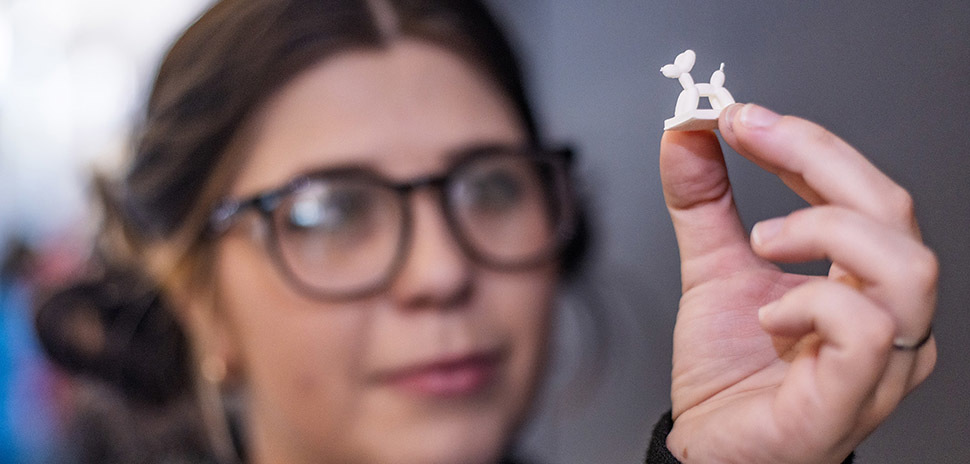
UT Dallas doctoral student Rebecca Johnson holds a balloon dog made from 3D-printed foam. The shape served as a proof-of-concept, showing how the material can be formed into complex, flexible designs. [Photo: UTD]
by Lance Murray • Jun 17, 2025
You may not notice it, but foam is everywhere—inside cushions, helmets, even car bumpers. A team at UT Dallas is reinventing it.
你可能未曾留意,但发泡材料无处不在 —— 坐垫、头盔甚至汽车保险杠中都有它的身影。德州大学达拉斯分校的一个团队正在彻底革新这种材料。
Blending chemistry and technology, researchers have developed a 3D-printed foam that’s stronger, more flexible, and—unlike the polymer foam found in many everyday products—recyclable.
该团队将化学与技术相结合,研发出一种 3D 打印发泡材料,它比日常用品中的传统聚合物发泡材料更坚固、更柔韧,且具有可回收性。
“This is probably the longest project I’ve ever done,” said UT Dallas doctoral student Rebecca Johnson, who plans to complete her Ph.D. in chemistry in May. “From start to finish, it was a little over two years. A lot of it was trying to get the polymer formulation correct to be compatible with the 3D printer.”
“这可能是我做过的耗时最长的项目,” 计划于 5 月完成化学博士学位的德州大学达拉斯分校博士生丽贝卡・约翰逊说,“从开始到结束,耗时略超两年。其中大部分工作是调整聚合物配方,使其能与 3D 打印机兼容。”
The research, published in the March 1 print edition of RSC Applied Polymers, a journal of the Royal Society of Chemistry, focuses on designing a sturdy yet lightweight foam that can be 3D-printed. Johnson noted that while making new materials for 3D printing is challenging, the process enabled the team to create customized, complex shapes.
这项研究发表于英国皇家化学会期刊《RSC 应用聚合物》3 月 1 日印刷版,聚焦于设计一种可 3D 打印的坚固且轻质的发泡材料。约翰逊指出,尽管为 3D 打印研发新材料极具挑战性,但该工艺让团队能够制造出定制化的复杂形状。
[Photo: UT Dallas]
Highly flexible material offers broader applications
高柔韧性材料拓展更广泛应用场景
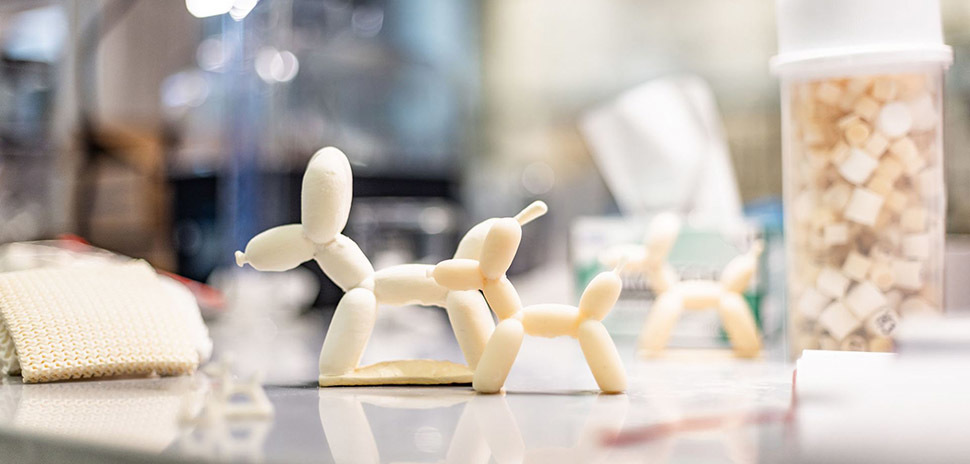
To demonstrate the proof-of-concept, the researchers produced foam in the shape of a balloon dog.
为验证概念可行性,研究人员制造了气球狗形状的发泡材料。
“The goal of the project was to address some limitations in 3D printing in terms of making polymer foam,” said Dr. Ron Smaldone, associate professor of chemistry and biochemistry in UTD’s School of Natural Sciences and Mathematics and corresponding author of the study. “One of the main uses, or interests, for 3D-printable foams is insulation and shock absorption.”
德州大学达拉斯分校自然科学与数学学院化学与生物化学副教授、该研究通讯作者罗恩・斯马尔多内博士表示:“该项目旨在解决 3D 打印制备聚合物发泡材料时存在的一些局限性。3D 可打印发泡材料的主要用途之一,或是研究热点之一,在于隔热和减震。”
Smaldone said the foam could one day be used in high-impact products such as motorcycle or football helmets, car bumpers, or armor. 3D printing also enables finer lattice structures, increasing the flexibility and versatility of the material.
斯马尔多内表示,这种发泡材料未来可能应用于高冲击场景产品,如摩托车头盔、橄榄球头盔、汽车保险杠或防护装备。3D 打印还能构建更精细的晶格结构,提升材料的柔韧性与适用性。
UT Dallas said the researchers also studied how to produce foam that prints consistently without defects. Most commercial foam is thermoset—once formed, it can’t be reshaped or melted, making it non-recyclable and landfill-bound.
研究人员还探索了如何制备出打印质量稳定、无缺陷的发泡材料。大多数商用发泡材料为热固性材料,成型后无法重塑或熔化,难以回收,最终只能被填埋。
Using dynamic covalent chemistry, the team developed foam with reversible bonds. While the material can’t be remelted like plastic, it can repair itself when damaged, making it more versatile and longer-lasting.
该团队利用动态共价化学技术,研发出具有可逆化学键的发泡材料。尽管这种材料无法像塑料那样完全熔化重塑,但受损时可逆化学键能使其自我修复,从而延长使用寿命并拓展应用场景。
“We’re certainly not the only ones trying to do this,” Smaldone said. “The novelty is using dynamic chemistry to print really great foam material. The next question to address will be, how do we tune the properties and use this new kind of knowledge to fit a variety of different needs?”
斯马尔多内称:“我们并非唯一从事该领域研究的团队,创新之处在于利用动态化学技术打印出高品质的发泡材料。接下来要解决的问题是,我们如何调整材料性能,并运用这一新知识满足各类不同需求?”
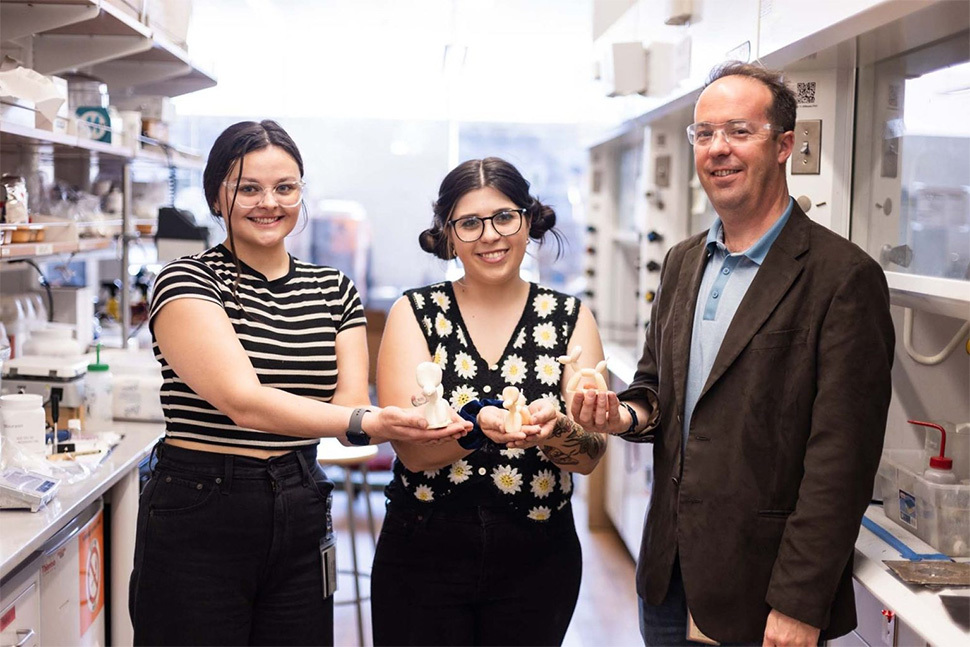
From left: Chemistry doctoral students Ariel Tolfree and Rebecca Johnson teamed up with Ron Smaldone, IT Dallas associate professor of chemistry and biochemistry, to create a next-generation 3D-printed foam—lightweight, flexible, and built for impact. [Photo: UT Dallas]
From lab to sustainability potential
从实验室到可持续发展潜力
Johnson and co-lead author Ariel Tolfree, also a doctoral student in chemistry, built on earlier research in the field. Tolfree credits Johnson as her mentor and said she hopes to advance the work by making the foam more recyclable and studying its sustainability.
约翰逊与共同主导作者、同为化学博士生的阿里尔・托尔弗里在该领域早期研究的基础上开展了此项工作。托尔弗里称约翰逊是她的导师,并表示希望通过提高发泡材料的可回收性及研究其可持续性来推进这项工作。
“It’s a simple shape but perfectly represents our foams,” Tolfree said of the balloon dog. “A balloon seems ordinary until it’s twisted into something new, almost defying expectations. Our foams are the same—unassuming at first, but once expanded and transformed, they become something remarkable.”
“这是一个简单的形状,但完美展现了我们的发泡材料,” 托尔弗里谈及气球狗时说,“气球本身很普通,直到被扭成全新的形状,几乎超出预期。我们的发泡材料也是如此 —— 起初平淡无奇,但一经膨胀和塑形,就会变得非凡出众。”
A team effort backed by national support
国家支持下的团队协作成果
Additional UT Dallas co-authors of the study are mechanical engineering doctoral student Gustavo Felicio Perruci; chemistry doctoral students Lyndsay Ayers and Niyati Arora; chemistry senior Emma Liu; Vijayalakshmi Ganesh, and Dr. Hongbing Lu, professor of mechanical engineering and the Louis Beecherl Jr. Chair in the Erik Jonsson School of Engineering and Computer Science.
该研究的其他德州大学达拉斯分校共同作者包括:机械工程博士生古斯塔沃・费利西奥・佩鲁西、化学博士生林赛・艾尔斯和尼亚蒂・阿罗拉、化学专业大四学生艾玛・刘、维贾亚拉克希米・加内什,以及机械工程教授、埃里克・琼森工程与计算机科学学院小路易斯・比彻尔讲席教授吕红兵博士。
The research was funded by The Welch Foundation, the National Science Foundation, and the Department of Energy.
该研究得到了韦尔奇基金会、美国国家科学基金会和能源部的资助。
Quincy Preston contributed to this report.
*内容源自UT Dallas,翻译由AI生成